Getting Around Seoul: Subway, T-money, Climate Card and Taxis
 meeinup
Updated
Short answer: buy a T-money card at a convenience store, or a Climate Card at a subway ticket machine if you will ride a lot. Use Naver Map or Kakao Map for directions. A subway ride costs ₩1,550 (about US$1.2) with a card. For taxis, set up K.Ride or Uber before you fly, and keep your clinic's Korean address on your phone.
Before you land: three things to sort out
Seoul's subway is fast, cheap and labelled in English, and it reaches every area where visitors usually book skin and dental clinics: Gangnam, Sinsa, Apgujeong, Cheongdam, Myeongdong and Hongdae. You need three things, and none of them take long.
- A transit card. Either T-money or the Climate Card. Both are shown below with photos, step by step.
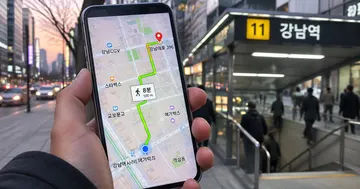
- A map app that works in Korea. Install Naver Map or Kakao Map and switch them to English. Google Maps shows places in Korea, but it does not give full transit or walking directions.
- ₩10,000 (about US$7.5) to ₩20,000 (about US$15) in cash. T-money is usually topped up with cash, and it is handy for small purchases on day one.
If you plan to take taxis, also install K.Ride or Uber before you fly. The taxi section explains why.
Which card should you get?
This is the only real decision. If you are staying three to five days and moving around every day, the Climate Card usually pays off. If you will only ride a few times, your clinic is on the Shinbundang Line, or you are taking a day trip outside Seoul, T-money is simpler.
| T-money | Climate Card (1–7 days) | WOWPASS | |
|---|---|---|---|
| How you pay | Per ride, from a balance | Unlimited rides for set days | Prepaid card with T-money built in |
| Cost | ₩1,550 (about US$1.2) per subway ride | ₩5,000 (about US$3.7) (1 day) to ₩20,000 (about US$15) (7 days), plus ₩3,000–4,000 (about US$2.2–3) for the card | Card fee, then per ride |
| Where to get it | Convenience stores, station machines | Subway ticket machines in Seoul | WOWPASS kiosks |
| Top up with a foreign card | No, cash | Yes, newer machines on Lines 1–8 | Payment balance yes; transit balance cash or via the app |
| Shinbundang Line | Yes | No | Yes |
| Outside Seoul | Yes | Mostly no | Yes |
| Best for | Few rides, day trips | Many rides a day in Seoul | One card for transit and shopping |
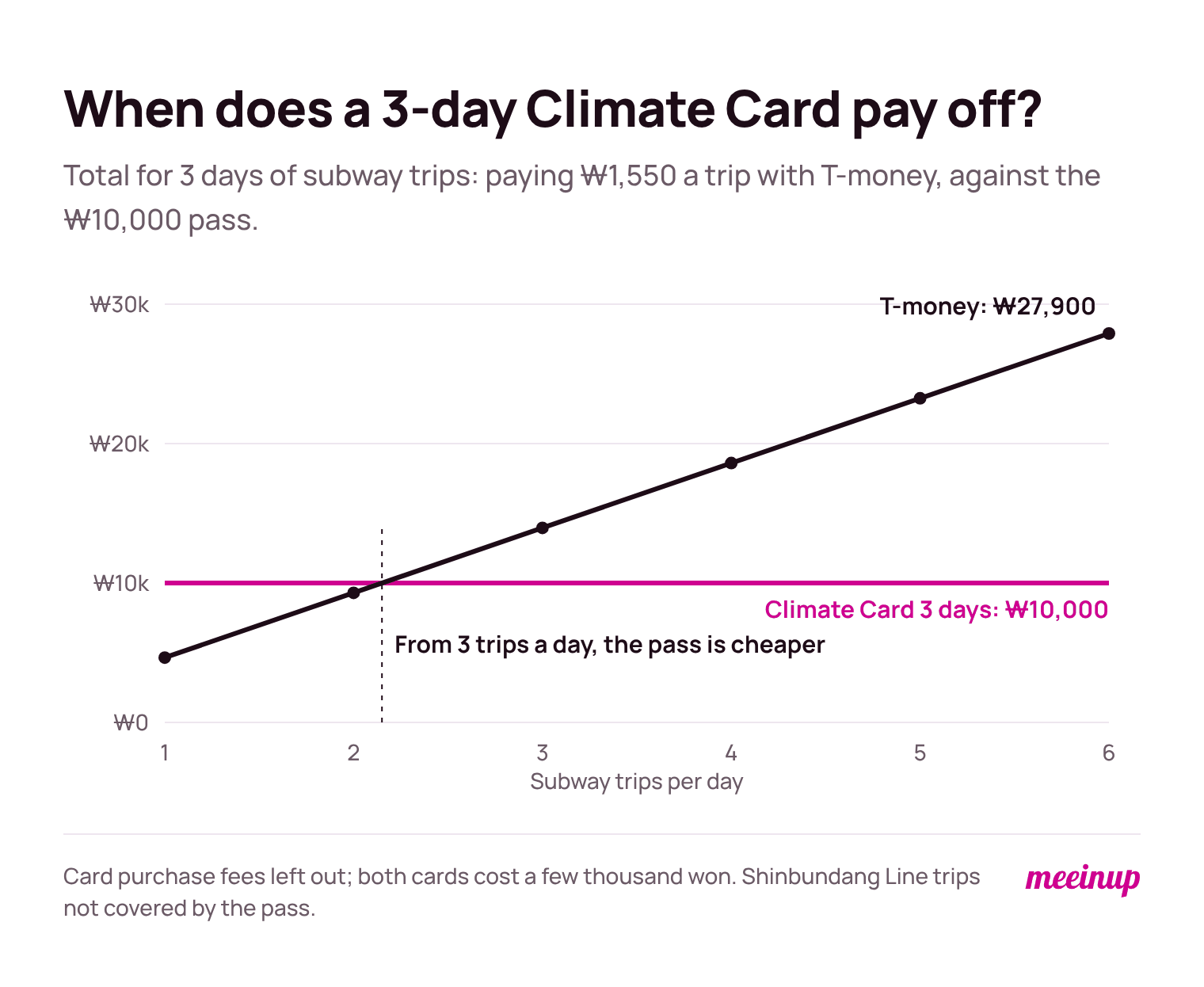
Over three days, a 3-day Climate Card costs less than paying per ride once you take three or more subway trips a day:
T-money, step by step
What a T-money card looks like
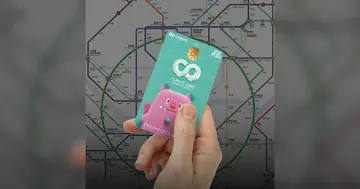
T-money is Korea's standard rechargeable transit card. It works on the subway, buses and many taxis, in Seoul and in other cities. Cards come in many designs, including cartoon characters. They all work the same way; look for the T-money logo on the card.
Step 1. Buy the card at a convenience store
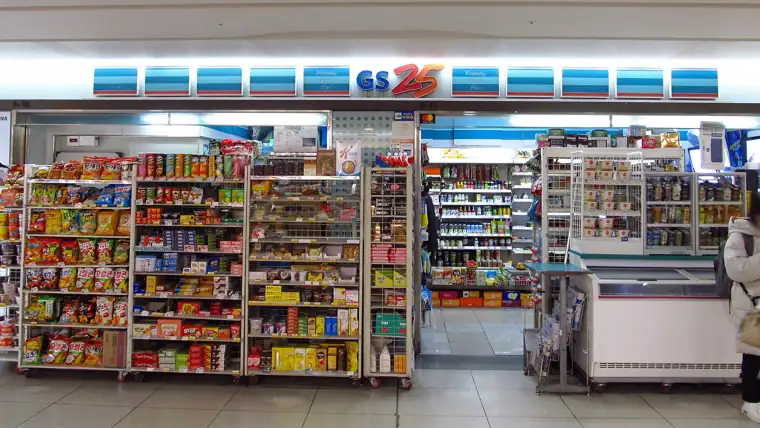
Go to any CU, GS25 or 7-Eleven, including the ones inside subway stations, and ask at the counter for a "T-money card". The card itself usually costs ₩3,000 (about US$2.2) to ₩5,000 (about US$3.7) depending on the design, and it starts with no money on it. The card price is not refunded later.
Step 2. Add money
The easiest way is at the same counter: hand over the card and the cash and say "chungjeon haejuseyo" (충전 해주세요, "please top it up"). You can also use the ticket and card reload machines in every station. They have an English button, but older machines take cash only.
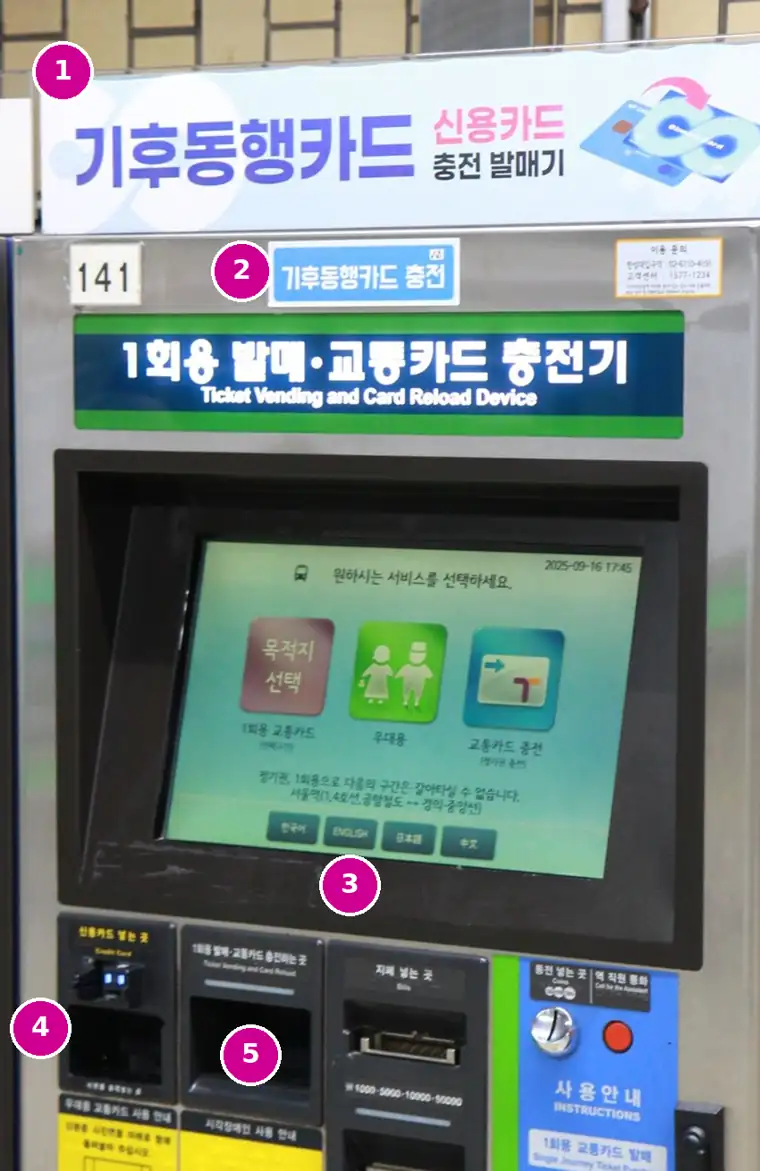
- The Climate Card sign. Only machines with it can charge the Climate Card; any machine tops up T-money.
- The Climate Card charging label.
- Tap ENGLISH, then choose the transit card top-up.
- The credit card reader (for the Climate Card).
- Put your T-money card in this slot and leave it there. Notes and coins go in the slots to the right.
Top up ₩10,000 (about US$7.5) to ₩20,000 (about US$15) at a time. Leftover money can be refunded, but only for a fee (Step 4).
Step 3. Tap in, and tap out
Hold the card flat on the reader at the gate until it beeps. The small screen shows the fare and your remaining balance. Do the same when you leave the station. On buses you tap when you get on and again when you get off.
Step 4. Get leftover money back before you fly
You can ask for your remaining balance back in cash. Convenience stores refund small balances (GS25 under ₩20,000 (about US$15), CU up to ₩30,000 (about US$22)), and the customer service centres in subway stations refund up to ₩50,000 (about US$37). A ₩500 (about US$0.37) fee is taken from the balance, and the card price is not refunded.
Climate Card, step by step
This is the short version. For where to buy it, when each day starts and ends, and a map of where it works, see our full Climate Card guide.
The Climate Card (기후동행카드) is Seoul's unlimited transit pass. Visitors buy the short-term passes:
| Pass | Price | Per day |
|---|---|---|
| 1 day | ₩5,000 (about US$3.7) | ₩5,000 (about US$3.7) |
| 2 days | ₩8,000 (about US$6) | ₩4,000 (about US$3) |
| 3 days | ₩10,000 (about US$7.5) | ₩3,333 (about US$2.5) |
| 5 days | ₩15,000 (about US$11) | ₩3,000 (about US$2.2) |
| 7 days | ₩20,000 (about US$15) | ₩2,857 (about US$2.1) |
On top of the pass, the physical card costs ₩3,000 (about US$2.2) to ₩4,000 (about US$3) (it was reissued as the Climate Pass in September 2026). The 3-day pass is the most popular: in the month after foreign cards were accepted, it made up 35% of short-term pass top-ups.
How to buy it
Since 17 March 2026 you can buy and top up the Climate Card with a Visa or Mastercard at 440 newer ticket machines in 273 stations on Lines 1 to 8. A fee of around 3.7% may apply to foreign cards. The menu wording can change, but the steps look like this:
- Find a newer ticket machine in a Line 1–8 station and choose English.
- Choose the Climate Card, and buy a new card if you do not have one yet.
- Pick the number of days: 1, 2, 3, 5 or 7.
- Pay with your card or cash, take the card, and tap it at the gate like T-money.
Where it works, and where it does not
The Climate Card covers Seoul's subway lines and Seoul city buses. It does not cover the Shinbundang Line or intercity and airport buses. On the airport railway it covers Seoul Station to Gimpo Airport, and you can get off, but not board, at Incheon Airport.
Two things catch visitors out. Each pass day is a calendar day that ends with the last train, so a pass charged late in the evening loses most of its first day. And stations in the cities around Seoul, such as Goyang, Gimpo, Seongnam and Hanam, are no longer covered by the short-term passes.
Check your clinic's line first. The Shinbundang Line links Gangnam and Sinsa, an area with many clinics. Sinsa is also on Line 3, which the Climate Card does cover.
If you stop using the pass early, you can ask for a refund before it expires: you get back what you paid, minus what you actually rode and a ₩500 (about US$0.37) fee. The 30-day pass stopped being sold after 31 August 2026; the 1 to 7-day passes are still sold.
WOWPASS, if you want one card for everything
WOWPASS is a prepaid card for foreign visitors, sold at WOWPASS kiosks in airports, hotels and major stations. You load money in 16 currencies and pay in shops like a debit card. It also has a T-money chip, but that transit balance is separate: top it up with won in cash, or move money from your WOWPASS balance in the app.
Riding the subway, step by step
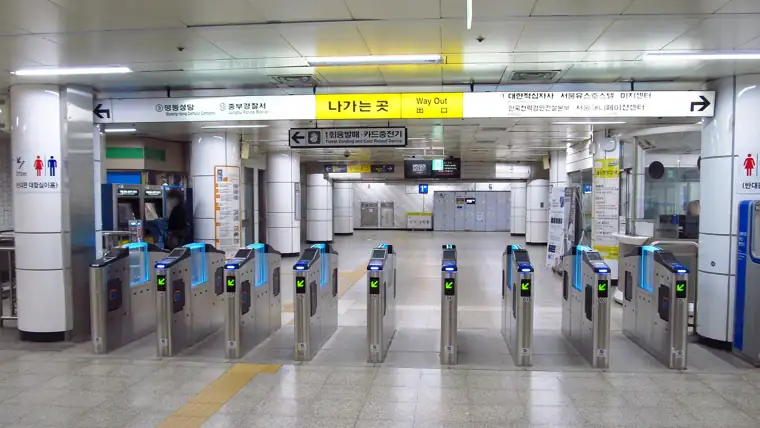
Step 1. Find the station entrance
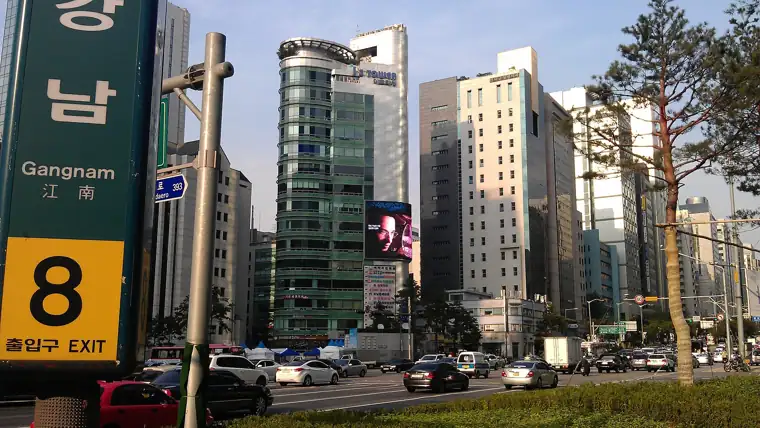
Every entrance has a large number. It is also the exit number you will use later, and clinic directions usually say which one to take.
Step 2. Go through the gates
Tap your card on the reader on top of the gate and walk through when it opens. You do not need to show a ticket to anyone.
Step 3. Find the right platform
Every line has a number and a colour, and every station has a number. Platform signs follow the same pattern on every line. This one is at Sinsa, a clinic area on Line 3:
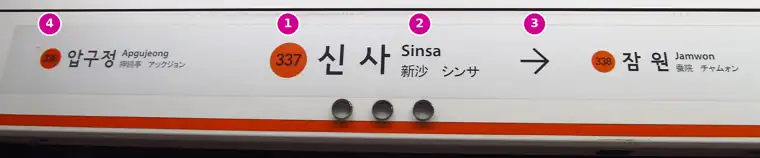
- Line colour and station number. Orange is Line 3; Sinsa is 337.
- The station name in Korean, English, Chinese characters and Japanese.
- The arrow points to the next station. Trains on this side go toward Jamwon (338).
- The station you just came from: Apgujeong (336).
Step 4. Ride, and change lines if you need to
Announcements and screens on the train are in Korean and English. To change lines, follow the coloured signs for your next line; you do not tap again inside the station.
Step 5. Tap out and take your exit
Tap your card again at the gate when you leave. Since 7 March 2026, if you forget to tap out on Seoul Metro lines, an extra base fare (₩1,550 (about US$1.2) for adults) is charged on your next trip. Then follow the signs to the exit number in your directions.
Trains are most crowded on weekdays from about 8 to 9 am and 6 to 7 pm. If you can, book clinic appointments outside those hours.
Riding a Seoul bus
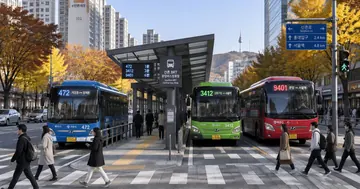
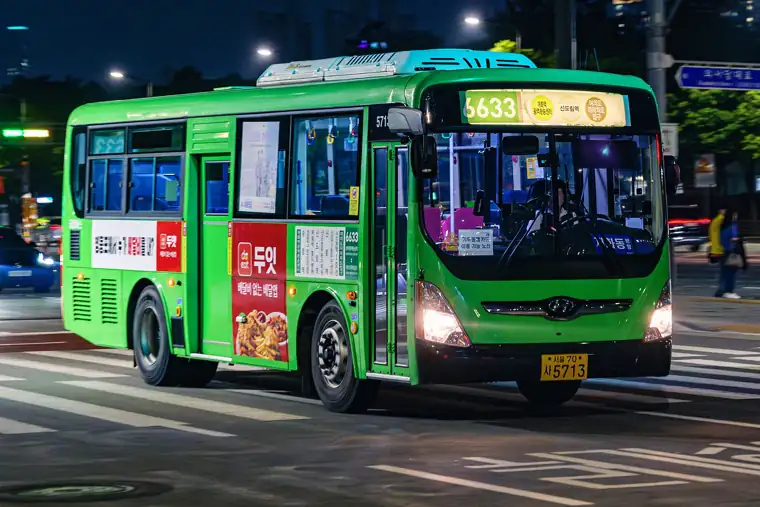
Buses are useful for short trips the subway does not cover well. Seoul's buses are colour-coded:
- Blue buses run long routes across the city.
- Green buses, including small neighbourhood buses, connect local streets to subway stations.
- Red buses are express buses between Seoul and nearby cities.
- Yellow buses circle downtown.
Our Seoul bus guide explains each colour, the fares and how to read the route number.
How to ride
- Get on at the front door and tap your card on the reader next to the driver.
- Press a red stop button before your stop.
- Get off at the back door and tap your card again on the reader there.
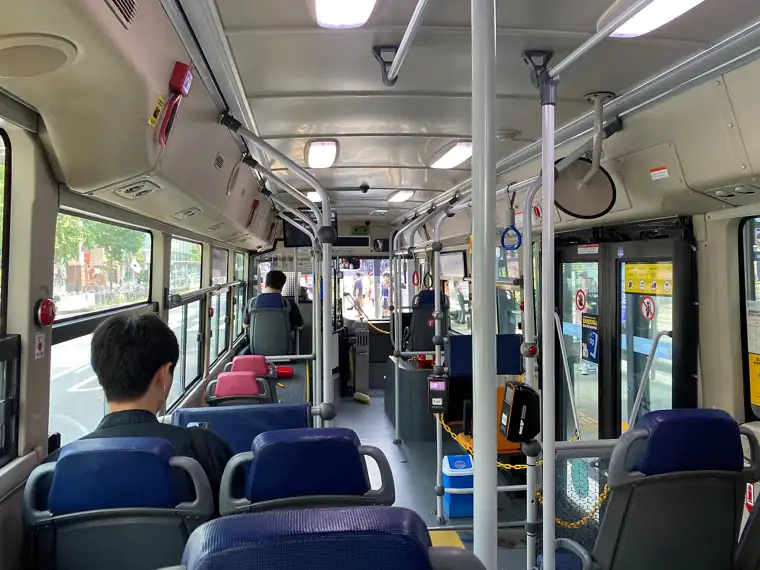
Tapping off matters: it is what gives you the transfer discount. If you board your next bus or train within 30 minutes of getting off (60 minutes between 9 pm and 7 am), you pay little or nothing extra, for up to four transfers in a row. Many Seoul buses no longer take cash, so use your card.
From your hotel to the clinic
Most visitors stay in Myeongdong or Hongdae and book clinics in Gangnam, Sinsa or Apgujeong. These are the routes we would take:
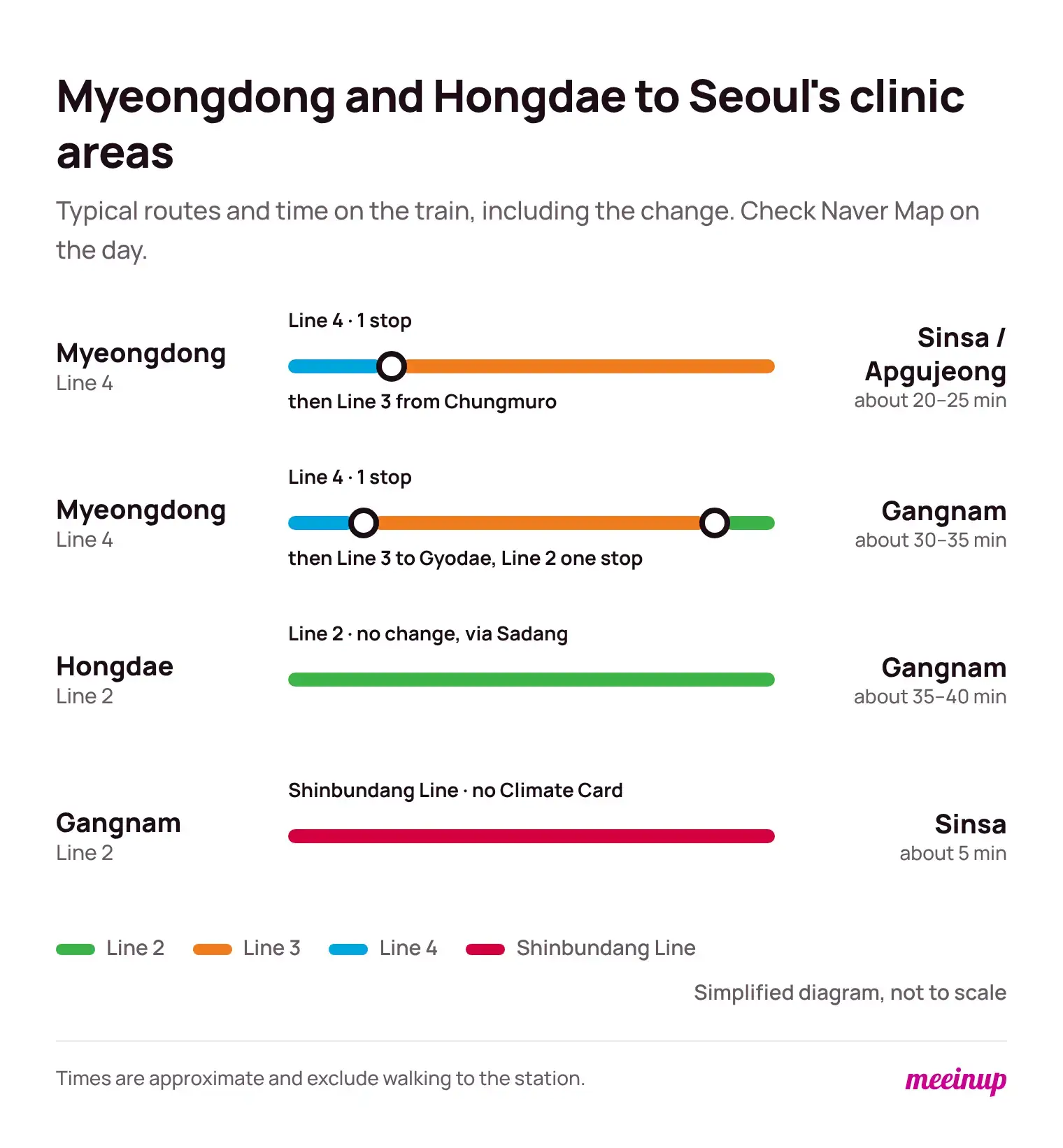
| Trip | Route | On the train |
|---|---|---|
| Myeongdong to Sinsa or Apgujeong | Line 4 one stop to Chungmuro, then Line 3 south | about 20–25 min |
| Myeongdong to Gangnam | Line 4 to Chungmuro, Line 3 to Gyodae, Line 2 one stop | about 30–35 min |
| Hongdae to Gangnam | Line 2 with no change, via Sadang | about 35–40 min |
| Gangnam to Sinsa | Shinbundang Line (not covered by the Climate Card) | about 5 min |
Every clinic page on meeinup lists the nearest station and its address in Korean and English, with buttons to open it in Naver Map or Google Maps. Check the station before you choose a hotel: staying on the same line as your clinic saves a change each way.
See clinics near Gangnam · near Myeongdong · near Hongdae
What getting around costs
| What | Adult fare | Notes |
|---|---|---|
| Subway | ₩1,550 (about US$1.2) | With a transit card, first 10 km; ₩1,650 (about US$1.2) with a single-journey ticket |
| City bus | ₩1,500 (about US$1.1) | With a transit card |
| Taxi, daytime | ₩4,800 (about US$3.6) | Base fare for the first 1.6 km |
| Taxi, 10–11 pm and 2–4 am | ₩5,800 (about US$4.3) | Night base fare |
| Taxi, 11 pm–2 am | ₩6,700 (about US$5) | Highest night base fare |
Taxis: fares and apps that work for visitors
A regular Seoul taxi starts at ₩4,800 (about US$3.6) for the first 1.6 km during the day. At night the base fare rises: ₩5,800 (about US$4.3) from 10 to 11 pm and from 2 to 4 am, and ₩6,700 (about US$5) from 11 pm to 2 am. A daytime ride from Myeongdong to Gangnam is often around ₩15,000 (about US$11) to ₩25,000 (about US$19), depending on traffic.
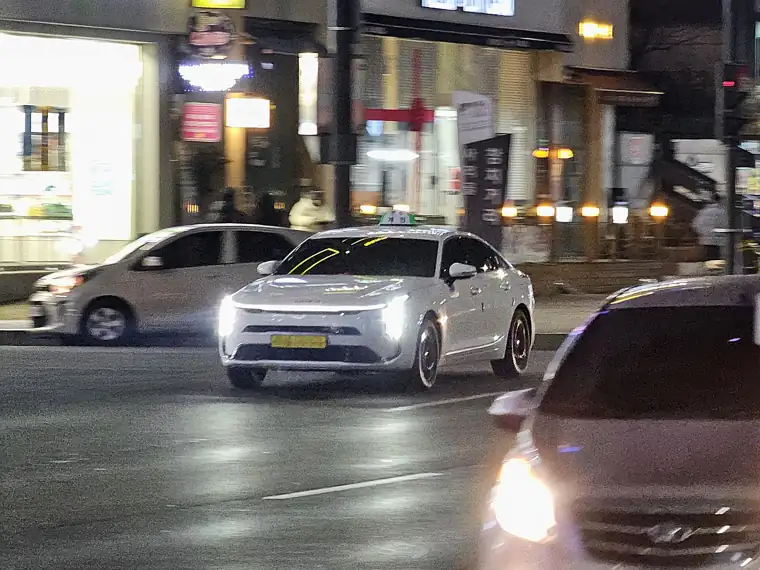
The app most Koreans use, Kakao T, needs a Kakao account and phone verification that often fails on foreign numbers. K.Ride, made by Kakao Mobility for visitors, lets you sign up with email, Google or Apple and pay with a foreign card. Uber also works in Seoul with your existing account.
| K.Ride | Uber | Kakao T | |
|---|---|---|---|
| Made for | Visitors, by Kakao Mobility | Your existing account | Korean residents |
| Sign up | Email, Google or Apple | Account you already have | Kakao account and phone check, often fails on foreign numbers |
| Foreign card | Yes | Yes | Mixed reports |
Show the Korean address. Many drivers do not read English addresses. Copy your clinic's Korean address from its meeinup page and show it to the driver, or paste it into the app.
Getting back after a treatment
After some skin treatments you may have numbing cream on, some redness, or a mask on your face. Many visitors find a taxi easier than a crowded train for the trip back, especially in the evening rush. Ask the clinic what to avoid afterwards, such as sun, heat or touching your face, and plan the trip home around it.
If you are booking several treatments, put the ones with more downtime near the end of your trip, so you are not crossing the city every day with a red face.
Apps to install before you fly
- Naver Map or Kakao Map for subway, bus and walking directions. Google Maps shows places in Korea but does not give full transit or walking directions.
- K.Ride or Uber for taxis.
- Papago for translating signs and messages to your clinic.
Frequently asked questions
Is the Seoul subway easy for tourists?
Yes. Signs and announcements are in English, stations are numbered, and trains run about every few minutes on the main lines. Use Naver Map or Kakao Map for directions, because Google Maps does not give full transit directions in Korea.
Should I get a T-money card or a Climate Card?
Get a Climate Card if you will ride the subway and buses several times a day inside Seoul. A 3-day pass is ₩10,000 (about US$7.5). Get T-money if you will ride only a few times, travel outside Seoul, or use the Shinbundang Line, which the Climate Card does not cover.
Can I pay for a Seoul taxi with a foreign credit card?
Most Seoul taxis take cards, and apps such as K.Ride and Uber let you register a foreign card. Kakao T, the app most Koreans use, often fails to verify foreign phone numbers, so set up K.Ride or Uber before you fly.
Do I need to tap my card when I get off a bus?
Yes. Tap again on the reader by the back door. It is what gives you the transfer discount if you take another bus or the subway within 30 minutes (60 minutes between 9 pm and 7 am).
Can I get my T-money balance back?
Yes, in cash. Convenience stores refund small balances and subway customer service centres refund up to 50,000 won. A 500 won fee is taken off, and the card price is not refunded.
Does Google Maps work in Korea?
It shows places, but it does not give full transit or walking directions in Korea. Naver Map and Kakao Map do, and both have English menus.
How long does it take from Myeongdong to Gangnam?
About 30 to 35 minutes on the train: Line 4 one stop to Chungmuro, Line 3 to Gyodae, then Line 2 one stop to Gangnam. Add a few minutes to walk to and from the platforms.
Find a clinic near your hotel
Every clinic on meeinup shows its nearest station, its Korean address and its opening hours.
Browse clinics in SeoulSources
- Seoul Metropolitan Government: Climate Card short-term pass prices
- Seoul Metropolitan Government: foreign cards accepted at ticket machines from 17 March 2026
- Seoul Metropolitan Government: lines covered by the Climate Card
- Seoul Metropolitan Government: short-term passes continue after the 30-day card ends
- Seoul Metropolitan Government: Climate Card refunds
- Seoul Metropolitan Government: integrated transfer discount
- Seoul Metropolitan Government: what the bus colours mean
- Kyunghyang Shinmun: short-term pass sales by type after foreign-card payments began
- Kuki News: subway base fare ₩1,550 (about US$1.2) by card, ₩1,650 (about US$1.2) in cash
- Dailian: Seoul taxi base fare and night surcharge amounts
- Kyunghyang Shinmun: penalty for not tapping out
- Seoul Metropolitan Government: Climate Pass card
- InfoArounds: T-money balance refund limits and fee
- HaniSeoul: Kakao T foreign card issues and K.Ride
- WOWPASS help: topping up the transit balance
Photos: LERK (CC BY-SA 4.0); Christian Bolz (CC BY-SA 4.0); LERK (CC BY-SA 4.0); LERK (CC BY-SA 4.0); TurnOnTheNight (CC BY-SA 4.0); Sgroey (CC BY-SA 4.0); Damian B Oh (CC BY-SA 4.0). All via Wikimedia Commons; numbers added by meeinup on one photo. Other photos by meeinup.